

 The choice to commission the build of a custom machine is a big decision, with a lot involved. For some people, the decision feels difficult even when the benefits are so inviting.
It's fun to identify opportunities to improve, especially with the big improvements offered by custom machines. But the path from idea to new machine is not usually simple or quick.
Over years of designing custom machines, we have gained experience worth sharing. Much of it comes down to clearly defining goals and success, choosing the right level of complexity, planning for the unexpected, and preparing for implementation.
Those ideas sound simple, of course. Putting them into practice and applying them to your situation is the key. Since this is not something you do every day, let's illustrate with some project examples.
Decisions To Start The Project
Jigs, fixtures and custom machines are all about getting things done faster, easier, with higher quality, and more consistently. These are great benefits, so why are the decisions hard?
The benefits are only one side. The investment, the unknowns, and the consequences of getting it wrong can make the decision feel hard. It is unfamiliar territory for many. So, what can be done to reduce the uncertainty? In a word, planning. So, we will talk through some important project planning points.
Yes, every project and every need is unique, so look for gems that apply to you. When you are ready, follow up with a conversation. We are here and always ready to discuss your needs.
Good Planning Reduces Uncertainty
"Risk" is a word I hear frequently, and it is worth considering. With everything in business, risk must be managed, of course, but I think there is an element of uncertainty with custom machines that amplifies feelings of risk.
If you buy a new building, you get to see it first, then move in next week. If you buy a new car, you get to drive it off the lot. If you buy a commercial machine, you usually get to try it first. However, with a custom machine, you input the specs, then it might be months before you even get to see the color of the paint. That can certainly feel exposed.
In other areas of business, we mitigate risk by leveraging things in our control. That is also the right attitude for capital investments like a custom machine. Level of complexity or automation are excellent things to plan, and they certainly affect cost estimates for custom engineering work. Good planning is one of the most important things within your control.
Planning in advance will make sure the specs are right, the scope is right, and the level of complexity is good. Planning while the engineering is being done assures you are ready to accept it, with your people trained and ready when it arrives.
What Real Projects Teach About Good Planning
Learning from others is a great way to see planning in practice. The examples below come from past Synthesis projects, each highlighting an area that deserves attention – goals, success, complexity, uncertainty, and implementation.
Clearly Defining the Goals
It is easy to focus narrowly on the most troublesome part of a process and say, “We need a machine to fix this.”
It is also easy to think grandiose, like Willy Wonka, and imagine everything perfectly and smoothly automated.
Your best option might be in the middle.
Before deciding what the machine should do, look at the goals, then clearly define what it should accomplish. Is the goal higher production, better quality, improved consistency, less manual effort, greater safety, or some combination?
Using the goals to set the scope also aligns expectations and defines many other areas for continued planning.
Here is one project where the goals – and therefore the scope – grew along the way.
Factory Automation – From a Synthesis Project
The biggest and most complex machine we have built is something we lovingly call SIM – the Strap Insertion Machine. The project started with the relatively small task of weaving steel straps through slots in each segment of a jointed stamping.
As the project progressed, the customer saw opportunities for the machine to accomplish more. The goals expanded to include a little more of this, then that, automating more of the factory processes. The final result was a fairly large, space-consuming factory automation machine.
There is so much going on in this machine – it is more like several machines coordinating together. Through design and development, there were many creative ideas to work out and plan. Special jigs and fixtures are inside the machine. Timing and sequencing are extensive, yet the pinnacle is bringing everything together to work as one.
To get a better idea of what it became, read the story and see the video, Custom Machine Demonstration.
Goal setting is not always a one-time event. As this customer discovered more value, we deliberately expanded what the machine should accomplish. Scope growth was a decision we made together – not scope creep.
Custom Factory Automation Machine Design and Build at Synthesis.
Defining What Success Looks Like
Processes often change when a machine takes over some aspect of the work. Tasks that workers perform easily must suddenly be defined in terms of mechanisms, controls, timing, accuracy, and durability.
That means success needs a definition. How fast must the machine operate? How accurate must it be? What parts will wear out, and what is the service interval? One machine did a lot of cutting, so blade change intervals became part of the plan.
In this example, we asked the customer: How many times will the actuator operate each day? or year? What is the desired lifetime? And, how will we test it to know those goals are achieved?
Defining success with a project is an important part of planning. It may be defined by one requirement, or by several.
Conveyor Controller – From a Synthesis Project
Accumulation conveyors are used in material handling operations like Walmart distribution centers and many other facilities around the world. They play a vital role in moving and distributing goods for stocking and loading trucks. Since they handle thousands of items, durability and dependability are critical.
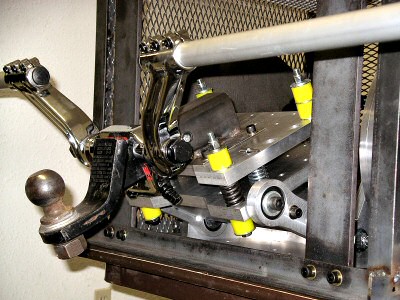
At Synthesis we designed and built the first prototypes of a conveyor engagement machine. Knowing that it must continually actuate over and over through its lifetime, durability was a focus, and that is something to test.
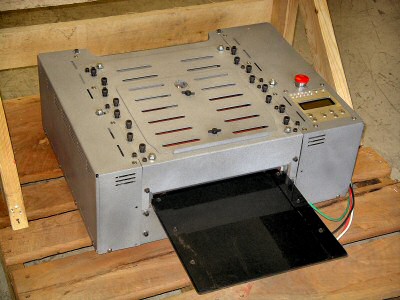
So, to prove the design, we tested the units non-stop for weeks. They actually wore out the crude testing machine, requiring us to remake some of the test fixture parts. After more than a million cycles, the customer was convinced. (See the prototype and testing image.)
These actuators are small custom machines that connect in a network. They are now produced in large volumes to meet demands of package handling facilities all over. Success for these is millions and millions of dependable cycles.


Choosing the Right Level of Complexity
What is the right level of automation for your new machine? Let's consider the options.
In the simplest form, a fixture can be passive, with no moving parts, yet provide an indispensable function. Cost to create it is often relatively low. If human judgment is required in the processes, or if operator interaction is needed in the task, then fixtures might be the right level of complexity.
At the active end of the spectrum, a fully automated, robotic machine does a lot of moving, sensing, and "thinking" to accomplish its job. With full automation, the cost and time to create a custom machine are usually much higher. In exchange, these machines typically require much less human interaction to keep the processes going.
Sometimes these feel like the only 2 choices. However, variations in the happy middle often provide excellent value with elements of both. We look more deeply at the decision in When Should You Automate a Manufacturing Process? For instance, a person might orient and insert the parts, then a machine performs the critical operations. A combination can remove complexity and cost while still providing the functions of greatest value.
The example below talks about a complex fixture (really a manual machine) with operator-actuated features and several interacting special tools. For this particular product and stage of development, it was the right level of complexity.
Sewing The Bones – From a Synthesis Project
This photo, taken through a microscope, shows parts for a tiny actuator in an early stage of manufacturing. For this product, Synthesis helped in design and development, then also designed the tools to manufacture it.

Various levels of automation were considered for production. However, for several reasons – primarily the need for 100% inspection – we recommended proving the product with assisted production. This allowed the company to refine the innovations and manufacturing process before investing significantly in automation.
To meet the need, we designed and built a set of manufacturing fixtures and special tools. While they were small enough to fit in your hand, they were also complex enough to perform the various needed functions.
The fixture is extremely accurate, yet made from robust A2 tool steel, heat treated to Rc60. Micrometer-driven adjustments provide precise alignment for forming the thin metal parts. Tiny 0.003" diameter wire is threaded around the small parts that look somewhat like bones. We call the process “Sewing the Bones,” with the tiny wires affectionately known as "dog hair."
After sewing, the fixture continues to hold things precisely while a 30-Ton press completes the assembly. It is quite a contrast – microscopic parts, delicate wire, then massive forces all working in the same manufacturing process.
The end product was unique enough and exciting enough that it was written up in Design News!
In this early lifecycle of the product, full automation was not the best answer. Assisted production gave the precision and control needed, while leaving room to learn and refine before committing to greater complexity.
Planning for the Unexpected
Custom machines rarely develop exactly as we first envision. Time in the design, calculations, testing, and hands-on experimentation can reveal better ways to manage parts or to accomplish a function.
Sometimes changes come from the customer, as with the SIM project above, where the goals and scope expanded along the way. Other times the engineering itself reveals something new – perhaps parts naturally interact differently than expected, or calculations uncover requirements that were not obvious at the beginning.
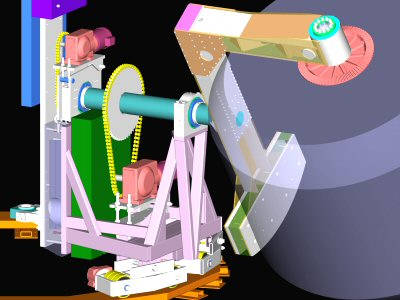
That happened with the Totem Pole machine below. In working through requirements for supporting and balancing the enormous mold, the design direction had to evolve.
Planning for the unexpected does not mean trying to predict every surprise. It means leaving leaving enough flexibility to respond when things point to a better solution. That mindset helps all of us work through changes without treating them as a crisis.
Totem Pole Custom Machine – From a Synthesis Project
A specialty manufacturer of very large rotationally molded tanks asked us to design a large custom machine. The requirements were substantial: lift a 10,000 lb mold, 12' in diameter, carry it into and out of a huge oven, while rotating it continuously in every orientation. The real challenge was doing all of that while supporting the mold from a single arm as a giant moving, overhanging mass.
Strength, balance, materials, heat, and motion all influenced the design. Large motors, mounted away from the oven heat, provide the power, while special tracks guide the machine through its movements.
The huge bevel gears supporting the mold became a major part of the engineering. The large ring gear is 42" in diameter and must support the 10,000 lb mold cantilevered from the machine. You may recognize these gears – an image of them appears as the background on the Synthesis home page.
Challenges in the design like the availability of motors and desired gear ratios, along with materials, strength, and even the operating space all affected the evolving design. Adjustments in one area had a cascading effect as the design developed. Even simple things like wheels, bearings, and balance created needs for changes.
And the name? We call it the Totem Pole because a 50,000 lb counterweight (made in several manageable pieces) stands vertically on the machine like a massive counterbalancing totem pole.
The planning lesson is not to predict every issue in advance. Instead, it is to allow flexibility in the project for new requirements and better solutions as they emerge.
Preparing for Implementation
Incorporating a custom machine often changes existing processes. Work previously done by hand may move to the machine, workflow may change, and operations that were difficult or less safe can become easier and safer.
Often that means rethinking how people are assigned, how shop space is used, and how the work flows. Fortunately, machine design and construction take time, providing an opportunity to plan for those changes before the machine arrives.
Most of our customers use that time effectively. Employees who will operate or manage the machine may come to our facility during final testing to learn how it works. Floor space can be prepared, and power, air, or other utilities can be in place and ready.
Coordinating details with the machine design helps make installation and startup smoother.
The next project was a little different because the custom equipment mounted directly on a tractor. Even so, preparing the equipment, people, and worksite made implementation go smoothly.
Safety On The Ski Slopes – From a Synthesis Project
This tractor-mounted custom machine has its own full story in Safety On The Ski Slopes. It was a fun project, and it also provides a useful example of planning for implementation.
Early on, the customer gave us access to the tractor for modeling, measuring, and determining how to integrate the new equipment. We then designed and built our portion before traveling to the ski slopes for installation.
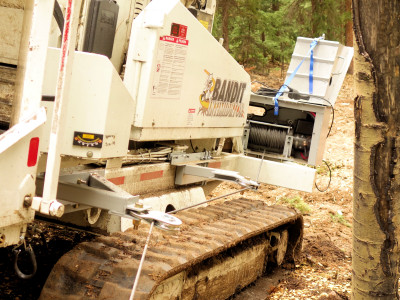
The customer was ready when we arrived. He had people available to help with installation and operators ready for testing. Good planning brought everything together smoothly, and the payoff came when we took it onto the steep slopes and everything worked just as expected.
From Planning to a Working Machine
The objective in planning is not to predict every detail, but to set a map for success. Good planning defines objectives, resolves what can be solved early, and leaves room to deal intelligently with new information along the way.
Done well, that planning carries through design, build, testing, installation, and ultimately to a productive machine. Every custom machine is different, which is part of what makes this work interesting.
If you are considering a custom machine design, we are happy to talk through the needs and the possibilities.
We will listen to understand your needs. Then, assess our ability to achieve your goals. If we can help, great. If not, that is OK too. The decision to move forward (or not) is always up to you.
More Custom Machine Examples
A frequent question from potential customers: "Can I see some samples of the machines you have made?" Of course.
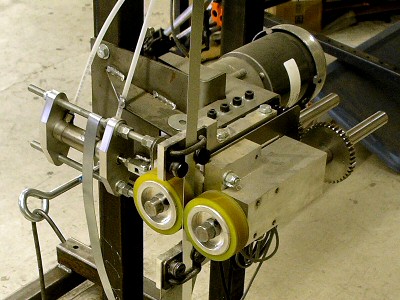
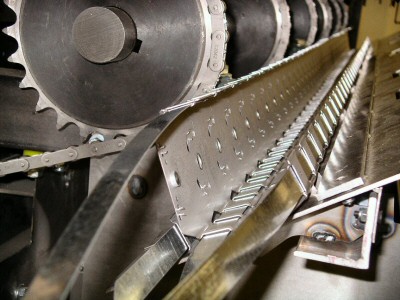
Here are several photos of various machines. Some perform factory automation functions, some are test stands, and some are simple manual fixtures. One is a contest winning catapult. All were designed at Synthesis, and most were also built here.
Manufacturing Assembly Machines

Production Acceleration
Durability Testing Machines
Automatic, On-Demand Material Feeding
Just For Fun Machines

Custom Manufacturing Machines

Small, Simple Machines

Complex Process Functions
Robotic Machines

Innovative Process Optimization

Adjustable Setup Machines

Unique Forming Functions

How To Categorize It?

Automated Packaging Machine

Built, Delivered & Installed

Building a Section
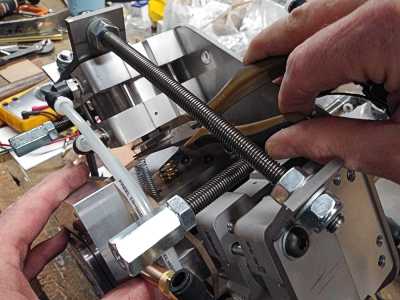
All of the above custom machines and fixtures are for specific customer requirements. Some of the componentry is off-the-shelf, some is new. We understand the need for both cost efficiency and for durability and dependability in custom machines - But, Function Above All. Read more about how we make Custom Equipment.
Please let us know if you have a need for jigs, fixtures, or custom machines.