

A few years ago, there was a terrible accident involving a single motorcycle traveling on the freeway. The cause listed in the police report: Engine & rear wheel lock-up. A terrifying incident!
Shortly after the accident, Synthesis was contacted and asked to perform a mechanical failure analysis to determine the cause of the rear wheel locking.
A Controlled Mechanical Failure Analysis
The case was not straightforward. Though the motorcycle was fairy new, it was equipped with some factory performance parts installed by a dealer. That meant the investigation needed to consider both the stock and performance components, as well as how the added parts were installed.
 As might be guessed, a lawsuit was the stimulus for the forensic investigation. For this article, that is important only because representatives from the various parties – the plaintiff, the involved dealership, and the manufacturer's engineering and legal departments – were invited to observe the tear-down and failure analysis.
Synthesis was retained as an independent engineering voice to perform a mechanical failure analysis – something the industry commonly calls a forensic investigation or forensic analysis. Our task was to work with the concerned parties and follow the physical evidence trail back to the source of the rear wheel lock.
For analysis, the wrecked motorcycle was delivered from the police impound to an uninvolved motorcycle dealer. That is where all the parties met in an open meeting for the tear-down and study.
As a formality for this meeting, the tear-down process was slow, methodical, and proceeded by consent. We stated what we were going to do in each step, asked the group if they agreed, and if they were ready. We then did the step, and allowed everyone to see, photograph, and ask questions as they wanted.
Examining the Motorcycle Step by Step
Forensic failure analysis is a meticulous process that requires a very thorough eye. Step by step we carefully examined everything we could see.
Our first step was an overview of the motorcycle from the outside, noting that police cut the drive belt at the accident location to move the motorcycle. Cutting the belt freed the rear wheel, so obviously the cause of the lock was upstream in the powertrain.
 The next steps involved clearing items from around the engine, and eventually opening it to view the sump area. We verified that oil was present, fairly clean, and in what appeared as an adequate quantity. There was metal debris in the oil, both aluminum and steel, in all different sizes. From what we could see, no parts were missing.
The next step in failure analysis was an examination of the engine top end. When nothing of significance was found there, we focused on the transmission. On closer examination, I noted that the clutch was still operational, and when actuated at the handlebar, it did disengage the driveline from the powertrain. (Interesting that no one tried this prior to my testing. The police cut the belt – the report stated that the drivetrain would not rotate.)
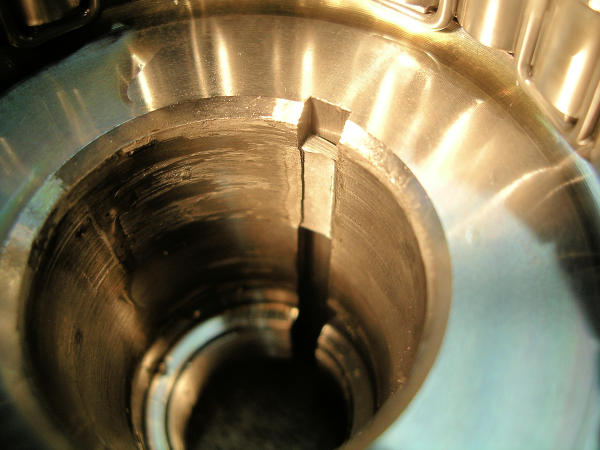
After pulling the engine, we found a gear in the transmission that did not quite align, and a small shaft that showed some distress. We also found catastrophic damage including a shaft key that sheared right in half (shown in the image), and bolts that broke.
Whatever happened, that was a lot of force – to shear a shaft key!?
Now we are getting to something.
Finding What Locked the Engine
After several more steps, we finally split the case to expose the full working interior.
 Of course, there was a bit of excitement as we could see the parts indicating a violent, sudden stop. I am enthralled with mechanical failure, especially when the failure is so final, yet perfectly contained, like in this motor.
We found the pieces that locked the engine.
The engine stopped suddenly because the balance shaft interfered with the crankshaft. The resulting impact brought the engine to an immediate and violent halt, which bent shafts, broke bearing races, sheared keys and much more. It was sudden, violent, and final.
Yet, this is an event considered mechanically impossible!? The engine design constrains the parts such that they cannot touch. So, how did they collide?
The cause was not in the sudden destruction – it was in the small details elsewhere. This is where the head scratching in forensic investigation began. We could see the evidence and the destructive results, but where did the events start? And why?
Tracing the Failure Back to Its Source
 Within this engine there were a lot of parts – most whole, and some in bits. Each one has a story to tell. There are small marks, and massive gouges, all indicating a string of events.
For the most part, I chose initially to ignore the major damage, assuming most of that happened all at once in the final split second. What I needed were the little things, that could happen quietly over time. I was looking for things that changed in the engine to allow direct contact between parts that are mechanically designed so they will never touch.
Through a long process of analyzing the various witness marks, looking through the debris, and using deductive reasoning, we developed a theory. I wish I could discuss more of the details and show a lot more photos, but unfortunately that is not appropriate. Suffice it to say, we developed a theory for a series of unfortunate events.
Yet, the theory alone was not enough to confirm the root cause. We needed more evidence to validate it.
Testing the Theory at the Metallurgical Lab
 Our next stop in the forensic investigation was a journey to the metallurgical lab.
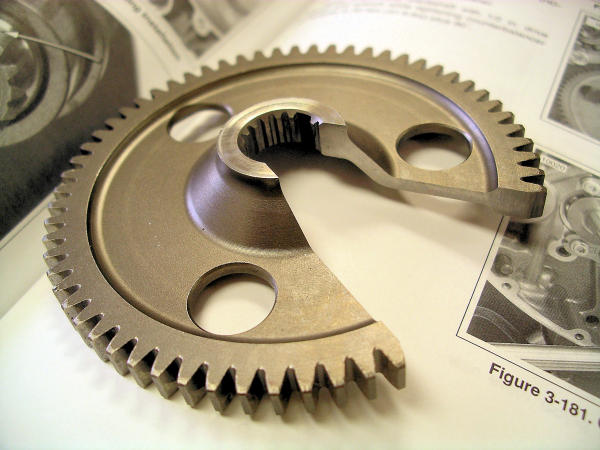
As a next step in determining the root cause, we got a little more personal with some key parts. At the metallurgical lab we were able to section a couple of key parts to see what was inside, and to measure the metallurgical properties. We did not test the alloy, but we did examine the heat treatment profiles – especially near the splines.
One of the parts turned out to be right within the specification – according to the manufacturer. The other, not quite.
This added data proved both useful and more confounding. The metallurgical results supported much of the theory, but not the whole thing. So, we went back to the tear-down to examine more of the parts and witness marks.
Identifying The Root Cause
Again, it is not appropriate to give all the details, but suffice it to say we did find what we all agreed were the missing pieces in identifying the root cause.
 The engine certainly ended as a sudden failure, but we suspect it took time. One little piece was not quite to spec, so it was loose. That allowed another component to fret through the splines of a shaft that did not have the necessary heat treatment.
Over time, with fretting, the balance shaft gradually gained more degrees of freedom until it was able to interfere with the crank.
For perspective, if a motorcycle engine averages 3000 to 4000 rpm, the crankshaft will rotate roughly a million times in just a few hours of riding. I suspect the wear condition developed over several million engine cycles, a tiny bit at a time.
The witness marks also told a story of repeated near misses or minor contact events between the crank and the balance shaft. We could see where the marks gradually changed over time as the impacts became more severe. It was probably an almost imperceptible degradation at first, accelerating as the damage progressed, until the parts finally collided catastrophically.
As with many aspects of a mechanical failure, there were several factors that came together just wrong. This is a story of how a few minor details combined to create a situation where a complete mechanical failure could occur.
What This Case Study Shows About Mechanical Failure Analysis
Our job in forensic analysis is to connect the evidence and clues to understand the events leading to the failure.
In this investigation, the evidence did not immediately point to the source. While the motorcycle engine had extensive internal damage, most of it occurred immediately before or as a result of the final engine seizure. Finding the source required following the evidence backward, paying attention to very small details, and understanding how components interacted over time. That takes diagnostic skill, careful observation, and the ability to pull seemingly unrelated clues into a coherent mechanical explanation. These are skills we offer.
Mechanical failure analysis and forensic investigation are part of the Engineering Consulting work we do at Synthesis. Sometimes, like in this case, there is a legal reason for the forensic investigation. Other times, it is a company investigating a failure for product improvement. We work with both situations.
If you have a mechanical failure that needs an independent engineering investigation, Contact Us. We can help examine the evidence, understand what happened, and work toward finding the root cause.
If a failure analysis points to the need for your own product changes, we can help with that too.
We had a new clutch plate explode 700 miles after a new engine and clutch were installed in our Camaro. Need to find out if it was a bad clutch plate or installation error. Is this something your company can do?
That can be hard. Do you have all the pieces? Yes, we have done stuff like that, but there is no guarantee the evidence will definitively point in one direction or another. We just have to dig in and see.