

Choose The Right
Utility Trailer
A Few Things To Consider . . .
. . . When Choosing A Utility Trailer.
There are many choices and options available with trailers. And, so many ways to customize them - especially for a utility trailer.
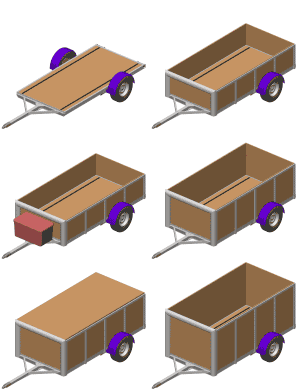 This guide helps navigate possibilities. Use these questions and thoughts to make a list of things that are important to you. Put priorities on the items, then the list becomes your personal Trailer Requirements List. Use the new list to help choose the right utility trailer.
Of course, you can use variations of this list for all trailers, but the items below are specifically focused on utility trailer choice.
For additional insight, you may also want to read our feature article on "What makes a good trailer design."
First Step: Discover the Need:
Obviously the trailer must first meet your needs -- how will it be used? It's not enough to say "I need a trailer to haul building supplies."
Is that bricks? . . . 10 Penny nails? . . . Or . . . 2 x 6 x 20's?
The truth is, if your situation is like most, the trailer will also be used for a lot of other things like moving furniture, hauling leaves, rocks and other equipment.
Take some time and think through your needs and all the possibilities - like your friends needs, your wife's needs, and your wife's friends needs. - Yes, I've been there.
Knowing how the trailer will be used is the first big step in your decisions toward the best utility trailer for you.
Consider the following questions about how the trailer will be used:
- How big should it be?
- Width: 4'? 5'? 6'? 8'? (What are the legal limitations in your state or province?)
- Length: 8'? 10'? 20'? (Where will it be stored?)
- What load Capacity is required? 1000#? 2000#? 3500#? 6000#? More?
- Is the bed height a factor? (How will you be getting things on and off?)
- Does it need Sides?
- What about a Top?
- Does it need Ramps?
- How about a Tailgate?
Step 2: Towing:
Is Your Trailer Hitch This Good?

A friend sent this picture, I didn't know where it came from until a paramedic who responded at the accident said it was in Big Thompson Canyon along the highway from Loveland Colorado to Estes Park. I know that canyon, . . . and that's one very luck driver!
Click the image to see it full size.
The second factor to consider is how the trailer will be towed.
- Will it be towed by a truck or other large vehicle? Or is the trailer to serve as a truck replacement?
- Will it be towed by the family car? Maybe a mini-van? Or an SUV?
- Is the utility trailer to augment the capacity of your truck? Or haul specific equipment?
- How far and how fast will the trailer travel?
- Are strong winds common in your area? Are mountains or sustained hills common?
- Is fuel economy important?
These questions are a good guide for choosing the right trailer size. Each vehicle has a towing capacity. Check the owners manual to see that your needs can be met with the vehicle you have in mind.
The trailer must meet the needs, but it must also be sized for the vehicle that will pull it. If your vehicle does not have a receiver (ball to hitch the trailer to) make sure you can mount one. There are lots of places that specialize in hitches. www.etrailer.com or www.reesehitches.com are good places to start.
Here are some more questions to think about with respect to towing:
- What vehicle(s) will tow the trailer?
- What is the towing capacity of the tow vehicle(s)?
- Can a trailer hitch be mounted to the vehicle?
- What is the height of the hitch point?
- Will the trailer need brakes? Hydraulic? Electric?
If a certain trailer width is not required (like for a certain piece of equipment), then it is usually best to make the trailer the same width, or only slightly wider than the tow vehicle. Going longer instead of wider helps with visibility, maneuvering, and reduces wind drag (better fuel economy). A longer trailer is also easier to load proportionally for towing stability.
Additionally, trailers that are significantly taller than the tow vehicle have much more wind drag. This can be costly in fuel, and can also cause trouble in cross winds on the highway.
Step 3 - Utility Trailer Storage:
A consideration which is often overlooked - Where will the trailer be stored? The answers to these questions will help determine your needs for trailer finish and shelter. They may also impact your decisions on trailer size.

A trailer stored out under a tree.
- Will the trailer be stored in a garage? (or other indoor facility?)
- If in a garage, will it be lifted or tipped on its side or end to make room for a car?
- Will it be stored outside?
- If outside, what shelter from the wind, moisture and sun are available?
- How much space is available for storage?
- Is the access convenient and easy? Or will it make the trailer difficult to access?
Whether you choose to build a utility trailer, or purchase one new, the investment is well worth protecting. On the other hand, if you can scrounge a cheap trailer to fill your need, shelter or protection may not be worth so much.
Check your neighborhood covenants too. Some places won't allow trailers to be stored outside - and your wife might be really upset if you put the car outside so the trailer can be in the garage! That is worth checking out.
Step 4 - To Build, or to Buy?

Build A Utility Trailer From Plans.
This is a classic question, and the answer is: That depends.
From the information above, you should have a pretty good idea of what you want or need. Next, find out if you can accomplish that with a purchased trailer. If not, consider building one.
I have designed a lot of custom trailers, and built a few too. I love building, and I love seeing other great projects. That being said, In my mind, there are only a few good reasons to build your own trailer:
- Do you want something special in the construction? Maybe a really strong or stiff frame?
- Or do you want a special feature or function?
- Do you want to add unique options or other customization?
- Perhaps you just love building stuff, and you want a cool project to be really proud of?
It is not usually cheaper to build one yourself -- that is, for a standard style utility trailer. Factories have economies of scale when purchasing big quantities of raw materials and components. They also have special jigs to build them quickly and efficiently. However, you get what they have. Usually the standard trailers are good for what they are -- though often on the weak side of specification.
If you need something special, or want something custom, it can be nearly impossible (or very expensive) to have a fab shop modify a trailer for you. So, if you have the skills, and if you have the reason, build it yourself! It's an awesome project, and when you're finished, you'll have reason to be super proud.
More Information
For more information on this topic, please read the Mechanic's Post at Mechanical Elements.
If you need trailer plans, we have them at MechanicalElements.com Build your own, and make it personal!
Put It All Together For The Right Trailer Choice
Now that you have a good idea of the requirements your trailer, it's time to shop. If you will buy one, check your local trailer shops (for new trailers), and online sources (for new and used trailers). See what you can find that meets your needs. Craigslist is a great place to find used trailers, and you can make it a local-ish search, but be patient if the right one doesn't show up on the first search.
If you are buying new, from a trailer store, please be careful of the "Sales Pitch". We have discussed the things above, so you are armed with knowledge. Don't let a salesman sway you from what you want because they don't have it in stock. Remember, you will probably have the trailer for a long time, so it is worth the wait if you need to look more or order it.
(I'm not trying to dis salesmen. They have a job to do, and their best interest is sending out out the door with a trailer. To them, it's over when the commission is paid. On the other hand, you will have the trailer a long time. - Just be aware of this important difference.)
Finally, if you decide to build, congratulations. I personally love a good project. Find the right utility trailer plans as a basis, then customize the trailer so it perfectly meets your needs.
 Return To: What Makes a Good Trailer Design
Or Next Up: Trailer Towing Tips
