

Choose The Right
Utility Trailer
Tips For Better Trailer Towing
Things To Think About Every Time You Tow
. . . looks as simple as hooking up and going! That's part of it, the enjoyable part, yet there is more to it. To be responsible and have a Trouble Free Trip, there are a lot of little things to think about and do - like the ideas in the Trailer Towing Tips list below. Certainly there's the safety of you and others, but more to the point, any trouble or delay along the way just adds frustration and makes things miserable - instead of fun. Let's avoid that.
Here is a list of trailer towing tips - hopefully as a gentle reminder - that can go a long way toward making your trip pleasant. If you have tips to add, please let us know.
The Tips List - On your way to a Trouble Free Trip.
Inspection
- Secure all bolts and other fasteners in vibration resistant ways – use Nyloc nuts, Loc-tite, cotter keys or wired nuts. Be sure the methods are appropriate for the situation.
- Check bolts, fasteners, hitch, tires, lights and brakes - every time - prior to towing.
- Inspect the trailer frame (and other structural areas) regularly to assure there are no cracked welds, loose bolts, or other issues for problems.
- Inspect the tires carefully – especially after storing the trailer for a while. Dry rot is the #1 root cause for failure of trailer tires. (Keeping a cover over tires in storage will help reduce dry rot and cracking.)
- Check tire pressure regularly when traveling. It's a good idea to kick the tires when you stop for gas just to see if they are all at proper pressure.
- Set tire pressure appropriate for the load. When is traveling empty, tire pressure may be reduced to 10 or 15 psi. This will allow the tires to absorb bumps and other anomalies which keep the trailer from bouncing around, and shaking the tow vehicle. Full tire inflation pressure is needed for a full load.
- Inspect the spare tire inflation too. And, make sure it's in good condition. There's not much worse than getting a flat and realizing your spare is also flat.
Preparation Each Trip
- Before connecting, check the hitch components to be sure they match - like ball size and coupler size. Also, check the rated capacity for both.
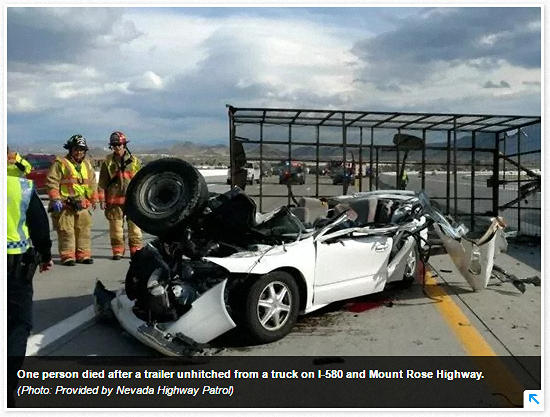
- After connecting, double-check the hitch to be sure it is secure. I have found it particularly valuable to check the hitch again after pulling it a block or so. This article talks about a tragedy that occurred when a trailer came loose.

- Use safety chains and secure them to a sturdy section of both the trailer tongue and the tow vehicle.
- Use tow chains that are adequate for the job - not wimpy, flimsy stuff. (If you have a 3000# trailer, make sure the chains are up for all of it.)
- Adjust safety chain length so they do not drag the ground. Adjust them long enough to reach the hitch, but also clear the ground. DO NOT TWIST safety chains to shorten them. See This Article and This One for ideas.
- For stability, distribute the load on the trailer evenly – not disproportionate on one side or the other if you can help it.
- Again, for stability, when trailer towing, 10% - 15% of the total gross trailer weight should be on the tongue (hitch).
Tips for Loading
- If you have a problem with swaying or instability, re-distribute the load. Most instability issues come from improper trailer loading. Other issues come from improper assembly (things not lined up or square). So, if you're building a trailer, take extra time and care when building a trailer.
- Don't overload the trailer! Check the capacity limits and stay within them, please.
- Be aware of the trailer towing limits of the pulling vehicle and the hitch components. Follow manufacturers guidelines on capacity for all the parts.
- Don't overload the tires. Tires on trailers often have a lower capacity than the axle they are mounted on. This is a great way to have a blow-out.
- Secure the load so it won't shift or move while in transit.
- Keep a low center of gravity with the load. This makes all the dynamics better.
- If loads are tall, realize that wind loading can be very strong. Make sure everything is securely fastened to the trailer. You wouldn't want something to blow out or break off. And, you really don't want the trailer to tip over (like in a strong crosswind).
Take Responsibility
- You are responsible for the load in your trailer. Anything that blows out or falls off is your responsibility. Not just as litter, but flying items can cause significant damage, injure or kill others. Be sure things are secure!!
- Double check tie-downs, tarps, ropes, etc. to be sure nothing will be "flapping in the breeze" or dragging the ground.
- It's a good idea to stop and double check the load, the tie-downs, and the overall situation after driving a few miles too. The load will "settle in" with the vibrations and bumps and wind of the road.
- If the trailer has high sides or a tall load, avoid traveling when significant cross winds are present. (Think Wyoming where it's not uncommon to see trailers laying on their side.)
- Allow added distance for acceleration and braking. Even if the trailer has brakes, it can take (most times) a lot more distance to stop.
- Allow more girth around corners - take the corners wide - to avoid hitting the trailer tires on a curb. The trailer makes a shorter radius turn than the tow vehicle. Also, the longer the trailer, the more space it takes. Hitting curbs and posts may cause big damage to wheels and tires resulting (sometimes) in high costs.
- Drive with a greater awareness of what is happening around you on the road. Any maneuvering on the road requires more time, more care and more space when a trailer is attached. Oh, and the larger the trailer, the more it takes..
- When you tow a trailer you assume a larger responsibility. Please drive carefully.
The Rest Of The Story . . .
Follow the Trailer Towing Tips above, and you'll drastically improve your odds of trouble free travels. These trailer towing tips are proven, over years and millions of miles. Take a little time to do it safe, and you will have a lot more fun.
For more information about trailers and towing, our Articles section for links to additional articles about trailers:
- What Makes a Good Trailer Design - Factors affecting Strength, Stability, and Versatility
- Choosing the Right Utility Trailer - Things to look for and things to avoid when choosing a trailer.
- Trailer plans - Great plans, designed by us, are available at MechanicalElements.com
Good Luck !! And Please Drive Safely.
